The Big Questions Card Game
The Big Questions | Ngā Pātai Nui
A bilingual card game for conversations that matter.
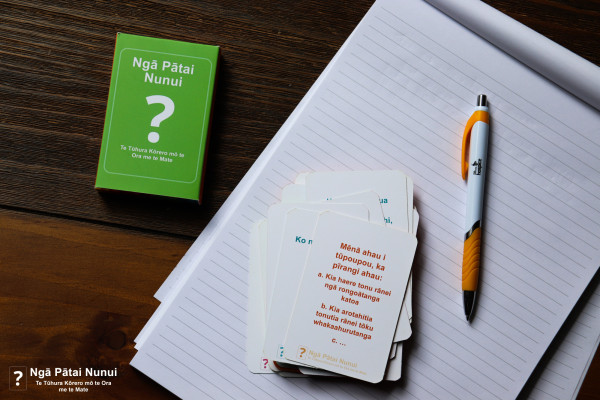
The Big Questions is a simple, approachable way to get people thinking and talking about what really matters to them. Designed for individuals, whānau, friends and professionals, the cards can help start conversations about life, values, hopes, care and the future.
No rules. No right answers. No pressure. Just kōrero.
Think. Share. Listen. Connect.
Because sometimes one question can start a much bigger conversation.
Get your pack here: https://www.trademe.co.nz/a/search?member_listing=9752519
Where the idea came from
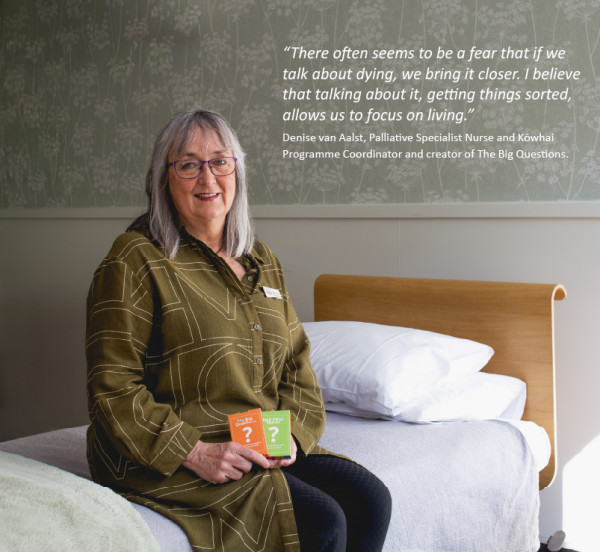
The Big Questions was created by Denise Van Aalst, a Palliative Specialist Nurse who leads the Kōwhai Programme at Otago Community Hospice. Denise has worked in palliative care for more than twenty years, and over that time she has seen many families struggle because they didn’t know what their loved one would have wanted.
The Otago Community Hospice had previously used Go Wish, a card game from the United States. “It was good,” Denise says, “but I always felt it would be so much more valuable if we had a New Zealand approach, recognising our own culture and values.” She also wanted the cards to go beyond dying and cover how we live.
Many people find it hard to raise anything to do with death and dying, and some worry that talking about it brings it closer. Denise sees it the other way round. “I believe that talking about it, getting things sorted, allows us to focus on living.”
How the cards were made
Denise worked with a small group of palliative colleagues to choose and word the questions. They began with the Go Wish cards as a starting point but soon realised they wanted something quite different: broader topics, as much about life as about death, and room for some fun along the way.
The whole hospice team played an early trial game, and the cards were also taken to external groups for feedback. Some questions drew strong reactions, both positive and negative, and the team had to choose carefully to keep the pack to a manageable size. What Denise expected to take two or three months ended up taking twenty.
Te reo Māori at the heart of it
Every card is bilingual. “Anything that wants to be a true reflection of New Zealand culture and values has to be bilingual,” Denise says.
The translation was done with Keanu and Harlam from Mairehu Consultancy. For Denise, the process became a chance to learn about te ao Māori and how Māori view and approach life and death. “Their approach was so genuine, so thoughtful,” she says. Working with te reo also changed how she saw the questions themselves. “The Māori language is so poetic and has such a beautiful way of phrasing something in a much more descriptive way.”
Who the cards are for
Denise’s answer is simple: “Everyone, everywhere!”
The cards can be played with friends or whānau at any time. Talking about these things when no one is under pressure lets people keep it light and explore. When someone you care about receives a terminal diagnosis, the same conversations carry more meaning, and the cards can help families open them up.
Importantly, the game isn’t about one person. Everyone who plays gets to share, so the focus doesn’t sit on the person who is unwell. “We get the chance to learn about each other, and ourselves perhaps as well.”
Getting started
If these conversations feel daunting, start small:
- Pull out one card a day, or play five cards once a week.
- Skip any card that feels too hard today.
- Mix in the lighter questions. Many are joyful, such as “What gets me out of bed in the morning?” and “What is my favourite memory so far?”
There’s no right or wrong way to play. The pack includes some suggested ways to use the cards, but you can use them in whatever way works for you.
Part of our wider work
At hospice we encourage people to talk about the things that matter. Often a patient or family member wants to understand someone’s wishes but doesn’t know how to bring it up, or assumes the other person won’t want to talk, and both may be thinking the same thing. “People are fiercely, beautifully, protective of their loved ones,” says Denise.
Through the Kōwhai Programme for whānau - we talk about ways to open these conversations, including making them a group discussion where everyone is heard. The Big Questions is one more way to do that. As Denise puts it, “After all, we will all die eventually.”
Denise’s own answers
Asked to choose a favourite card, Denise couldn’t pick just one:
“If my time were short I would want to…” “Spend it with the people I love. I don’t mind where we are or what we are doing, I just want to spend time with them. Tell them how much I love them and how proud of them I am.”
“What brings me joy is…” “My children and my grandchildren. They fill my heart and watching them live their lives just brings me so much joy.”
Her hope for anyone who plays is that they come away with “a deeper knowledge of the people they love, and of themselves too.”
Get your cards
Order online by following the links below, or pick up a pack in person from Otago Community Hospice on North Road, Dunedin.
https://www.trademe.co.nz/a/search?member_listing=9752519
For enquiries please email: bigquestions@otagohospice.co.nz